Breast Milk Storage Guidelines: How Long Does Pumped Milk Last?
You worked hard for every precious ounce, so the last thing you want is to second-guess whether it's still safe to feed your baby. Breast milk storage doesn't have to be confusing. With a few simple rules and a handy chart, you can pump, store, and serve your liquid gold with total confidence. Here's an easy, science-backed guide, aligned with World Health Organization (WHO) guidance, to how long breast milk lasts and how to keep it fresh.
The Golden Rules of Safe Handling
Before we get to timing, a few habits keep every drop safe from the start:
- Wash your hands with soap and water before expressing or handling milk.
- Use clean containers — food-grade, BPA-free bottles or dedicated breast milk storage bags with tight seals.
- Label every container with the date you expressed it (and your baby's name if using daycare).
- Store in small portions — 2 to 4 ounces — to avoid waste, since you can always thaw more.
- Cool before combining. If adding freshly pumped milk to already-chilled milk, cool the new milk in the fridge first, then combine.
Breast Milk Storage Chart (WHO-Aligned)
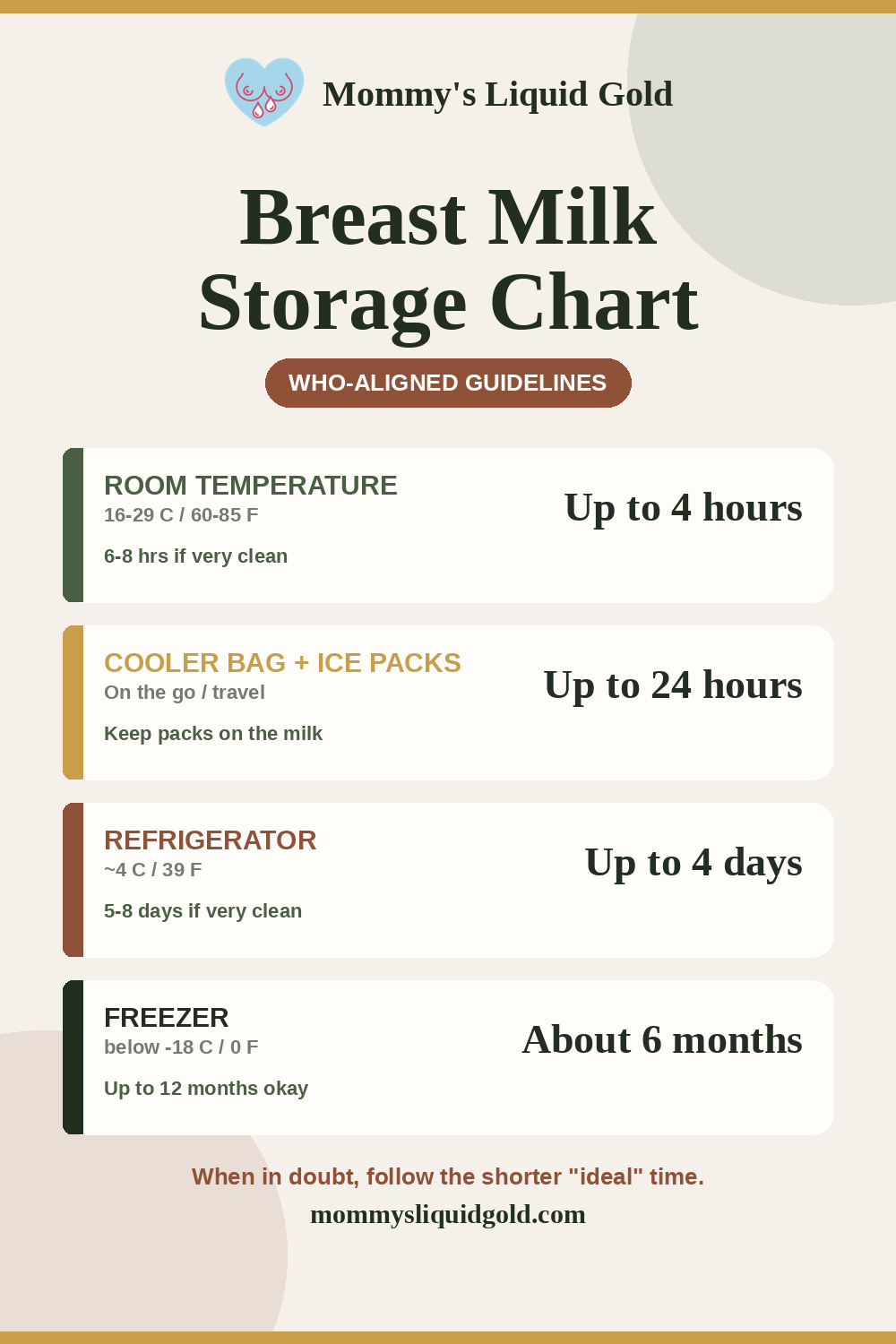
Here's the quick reference every pumping mama should screenshot. These times reflect WHO and other leading health-authority guidance for healthy, full-term babies:
- Room temperature (16–29°C / 60–85°F): up to 4 hours is ideal; up to 6–8 hours may be acceptable under very clean conditions.
- Insulated cooler bag with ice packs (~15°C / 59°F): up to 24 hours — perfect for the commute or a day out.
- Refrigerator (~4°C / 39°F): up to 4 days is ideal; up to 5–8 days is acceptable under very clean conditions.
- Freezer (below -18°C / 0°F): about 6 months is ideal; up to 12 months is acceptable.
When in doubt, follow the shorter "ideal" times — they preserve the most nutrients and immune protection, and they keep things safest.
 Save to Pinterest
Milk at Room Temperature
Freshly expressed milk is remarkably resilient thanks to its natural antibacterial properties, but it isn't invincible. Aim to use or chill it within about 4 hours, especially in a warm room. In a very clean environment and cooler temperatures, 6 to 8 hours can be okay, but if you know you won't use it soon, refrigerate or freeze it right away to lock in freshness.
On the Go: The Cooler-Bag Window
Heading to work, traveling, or spending the day out? An insulated cooler bag with frozen ice packs keeps expressed milk safe for up to 24 hours, which covers most commutes and workdays. The key is keeping the milk consistently cold and the ice packs in direct contact with the containers.
If you want to skip the bulky bag and loose ice packs altogether, a dedicated breast milk chiller makes on-the-go storage effortless. The Ceres Chill breastmilk chiller keeps milk safely cold for up to 24 hours in a single leak-proof, stainless-steel container — you can even pump straight into it and carry it home without hunting for a fridge.
Storing in the Refrigerator
The fridge is your everyday workhorse. Store milk toward the back on a shelf, never in the door, where the temperature swings each time it opens. Use refrigerated milk within about 4 days for the best quality. You may notice the milk separating into a creamy top layer and a thinner bottom — that's completely normal. Just swirl (don't shake) gently to recombine before feeding.
Freezing for the Long Haul
Building a freezer stash is a wonderful safety net for back-to-work, date nights, or a rainy day. For best quality, use frozen milk within 6 months, though up to 12 months is acceptable. A few freezer-smart tips:
- Leave room at the top of the bag or bottle — milk expands as it freezes.
- Freeze flat in storage bags to save space and speed up thawing.
- Practice "first in, first out" — use your oldest dated milk first.
- Store in the back of the freezer, not the door, for the steadiest temperature.
Freezer-Ready Storage Bags
Purpose-made storage bags freeze flat, seal tight, and label easily so your stash stays organized and leak-free. Zomee Breast Milk Storage Bags are pre-sterilized, BPA-free, and built to lie flat for space-saving, first-in-first-out freezing. Use code NursingMoma to save.
Shop Zomee Breast Milk Storage Bags →Thawing and Warming Safely
How you defrost matters just as much as how you store:
- Thaw slowly in the refrigerator overnight, or more quickly by holding the container under warm running water or in a bowl of warm water.
- Never use the microwave — it creates dangerous hot spots and destroys valuable nutrients and antibodies.
- Use thawed milk within 24 hours when defrosted in the fridge, and within about 1 to 2 hours once it's reached room temperature.
- Never refreeze milk that has already been thawed.
- Swirl, don't shake to remix the layers and evenly distribute the fat.
Warmed milk should feel lukewarm, not hot. Test a few drops on your wrist before offering it to your baby.
What About Leftover Milk After a Feed?
If your baby doesn't finish a bottle, bacteria from their mouth can enter the milk. Use leftover milk within 2 hours, then discard the rest. To minimize waste, warm smaller amounts first and top up if baby is still hungry.
How to Tell if Breast Milk Has Gone Bad
Breast milk naturally varies in color and can have a mild soapy smell (from a normal enzyme called lipase), which is usually still perfectly fine. Truly spoiled milk, however, will smell sour or rotten even after swirling, and may taste off. When a smell or taste clearly signals "off," trust your instincts and toss it.
Store With Confidence
Once you've got the chart in your back pocket, storing breast milk becomes second nature: keep it clean, keep it cold, label everything, and lean on the "ideal" times when you can. Your freezer stash is a gift to your future self, and every carefully stored ounce is a little act of love.
Ready to build your kit? Compare pumps in our guide to the best breast pumps, see our hands-on pump reviews, and save on bags, coolers, and more on our coupons page.
This article is for general education and is not medical advice, and storage guidance can vary for premature or hospitalized infants. Always follow your pediatrician's or a lactation consultant's advice for your baby.
Looking for the right pump?
Compare our top breast pump picks for every budget and lifestyle.
See the Best Breast Pumps